
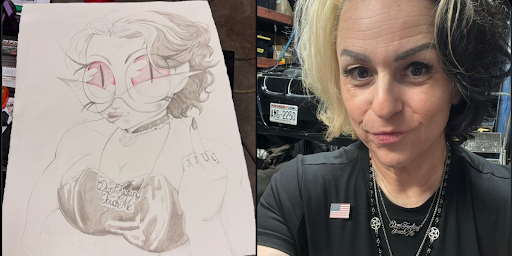
In November, transgender musician Katrina Deville announced a run for the U.S. House of Representatives, seeking to represent Wisconsin’s 8th Congressional District.
The district, which includes Green Bay and much of the Fox Valley, is currently represented by Republican Rep. Tony Wied. Katrina Deville is a man who identifies as transgender woman and publicly transitioned in 2024, is running in 2026 as a self-described “democratic socialist.”
Deville grew up in eastern Wisconsin and attended UW–Green Bay before later moving to Texas. She eventually returned to Wisconsin and became the lead of a musical group called Katrina DeVille and the Nobody Famous, a jazz-and-horns band. (RELATED: ICE Facility Inspections, Not Enforcement — Still Too Far for Oneida Nation)
Deville has never held elected office, having worked primarily as a musician throughout his career. He said he had long considered a new “life direction,” and decided to run because “our government actively creates and encourages hateful discriminatory policies.”
Deville’s campaign platform emphasizes expanded social programs and policies supporting transgenderism . According to his campaign, key goals include free child care, universal health care, removing tax-exempt status from churches, and skyrocketing the minimum wage to $22 per hour.
Deville argues that trans youth “are real”, a sensitive topic in Wisconsin, where transgender-related issues have become a major issue in some communities and fueled parent backlash over school and policy decisions.
In Madison, Republicans have introduced bills that would restrict transgender participation in sports by establishing sex-based participation rules for school athletics, as well as other proposals aimed at preventing gender-transition medical procedures for minors.
More recently, the American Society of Plastic Surgeons released a statement expressing concern about “gender-affirming” care for people under 19 who experience gender dysphoria. The ASPS said there is a “considerable amount of uncertainty” surrounding these interventions, and that existing evidence is “low quality” with “low certainty.”
Deville, a strong supporter of access to gender-related medical care, has argued such treatments should remain available to minors across Wisconsin. (RELATED: Huge Fundraising Gap to Start 2026 Wisconsin Supreme Court Race)